Your IBM Informix estate is an asset. We make it keep earning.
Vector search, fuzzy search, graph and change data capture — the modern data capabilities a PostgreSQL shop takes for granted, running native on IBM Informix. Each one verified against its PostgreSQL equivalent by per-row benchmark. You chose Informix because it works. Nothing here asks you to leave it.
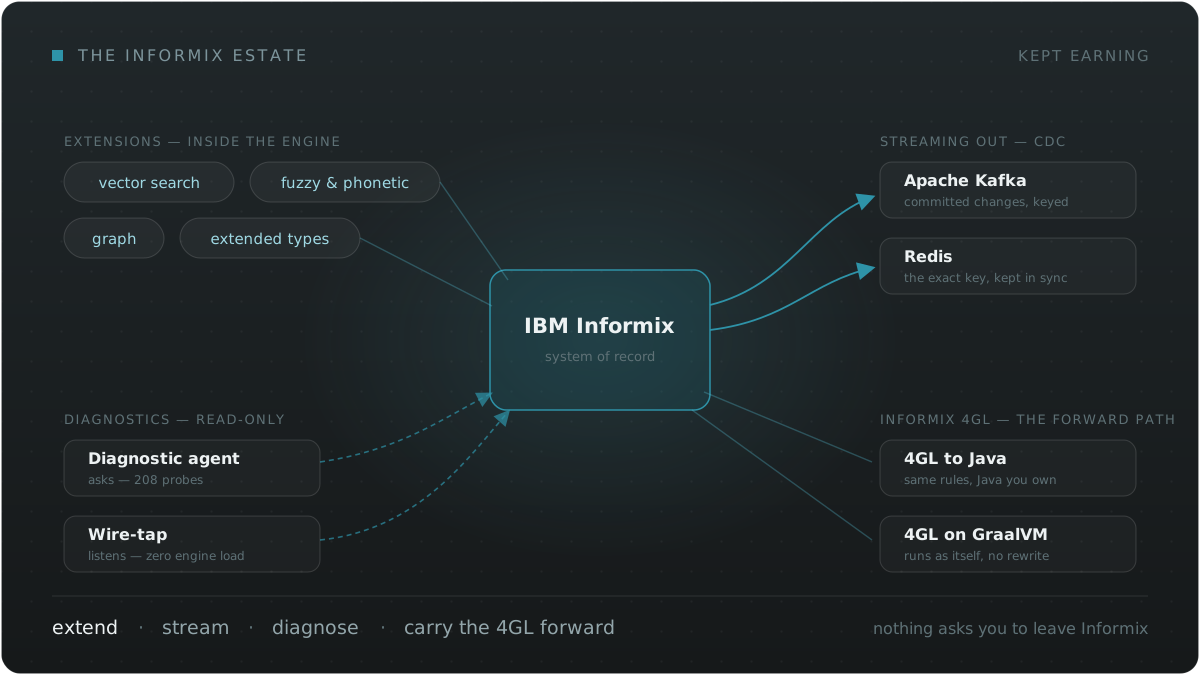
The estate is worth keeping
Informix quietly runs mission-critical OLTP for a generation of enterprises that chose it because it works. The question is rarely whether to leave it. It is how to do more with it.
Modern capability, same engine
Vector, fuzzy search, graph and extended types run as native extensions inside the engine you already have; change data capture streams committed changes out of it. No re-platforming, no engine swap, no rewrite of the application above it.
Production-safe by construction
A diagnostic run goes over a single connection, read-only, as the unprivileged database user. No host login, no agent installed on the server, minimal and self-cleaning footprint.
A forward path you choose
When the application tier is what limits the business, there is a route to modernise it — on your timeline, not ours. Offered when you want it, never the price of admission.
The capabilities a modern data platform is expected to have — on Informix
Most are native DataBlades — extensions that run inside the engine and answer in ordinary SQL. Two use change data capture, streaming committed changes out of the engine to Apache Kafka or to Redis. Each is verified against its PostgreSQL equivalent.
Vector search
A native DataBlade. A vector type compatible with the PostgreSQL pgvector model — variable-length embeddings, cosine, L2, inner-product and L1 distance usable directly in the query, and an approximate-nearest-neighbour index. Retrieval-augmented AI against the data already in Informix.
Fuzzy and phonetic search
A native DataBlade. Trigram similarity, edit distance and phonetic matching over ordinary character columns, with the same functions on Informix as on PostgreSQL. Search that tolerates typos, spelling variants and near matches, without a separate search cluster.
Graph queries
A native DataBlade. Graph traversal over relational data, matching the model the PostgreSQL ecosystem offers. Relationship-shaped questions answered on the estate that already holds the relationships.
Extended types
A native DataBlade. Extended data types and their functions, used from ordinary SQL, that close the gap between what Informix ships and what a modern application expects of its store.
Kafka change data capture
Change data capture. Committed row changes streamed from the Informix logical log to Apache Kafka as a change-per-message envelope, running as an external process outside the engine entirely. Integration and analytics fed from Informix without touching the application.
Redis cache
Change data capture. Committed row changes streamed from Informix to Redis, keeping a cache or stream in step with the engine as the system of record — the same capture model as the Kafka connector, a different destination.
Diagnostics
The read-and-optimise pair: an agentless diagnostic that triages the engine and host, and a passive wire-tap that finds the costliest statements on the wire. The place to start.
Why this is the right place to start
Most Informix owners have been told, for years, that their database is a liability to be escaped. It is not. It is a mission-critical asset that has done the work reliably for decades, and the cost of moving off it is almost always higher than the cost of doing more with it.
The work begins where the risk is lowest: a read-only diagnostic run of the estate you run today. From there, the modern capabilities are added to the engine in place. Only when the application tier is what holds the business back does a forward path onto a modern runtime become the conversation — and that path preserves the schema, the stored logic and the operational depth you already trust.
Informix on its own, and Informix with ifxtools
| Informix on its own | Informix with ifxtools | |
|---|---|---|
| Vector / AI retrieval | Not available in the engine | ✓ Native vector type and index, pgvector-compatible |
| Fuzzy and phonetic search | Hand-rolled or a separate search cluster | ✓ Native functions, same SQL as PostgreSQL |
| Kafka change data capture | Bespoke log tooling, per project | ✓ Log-based streaming to Kafka, nothing inside the engine |
| Graph queries | Modelled by hand in application code | ✓ Native graph traversal over the relational data |
| Diagnostics | A DBA logging in and running commands by memory | ✓ One connection, one run, one ranked report |
| Modernisation path | Rip-and-replace, or nothing | ✓ Optional, incremental, schema and logic preserved |